
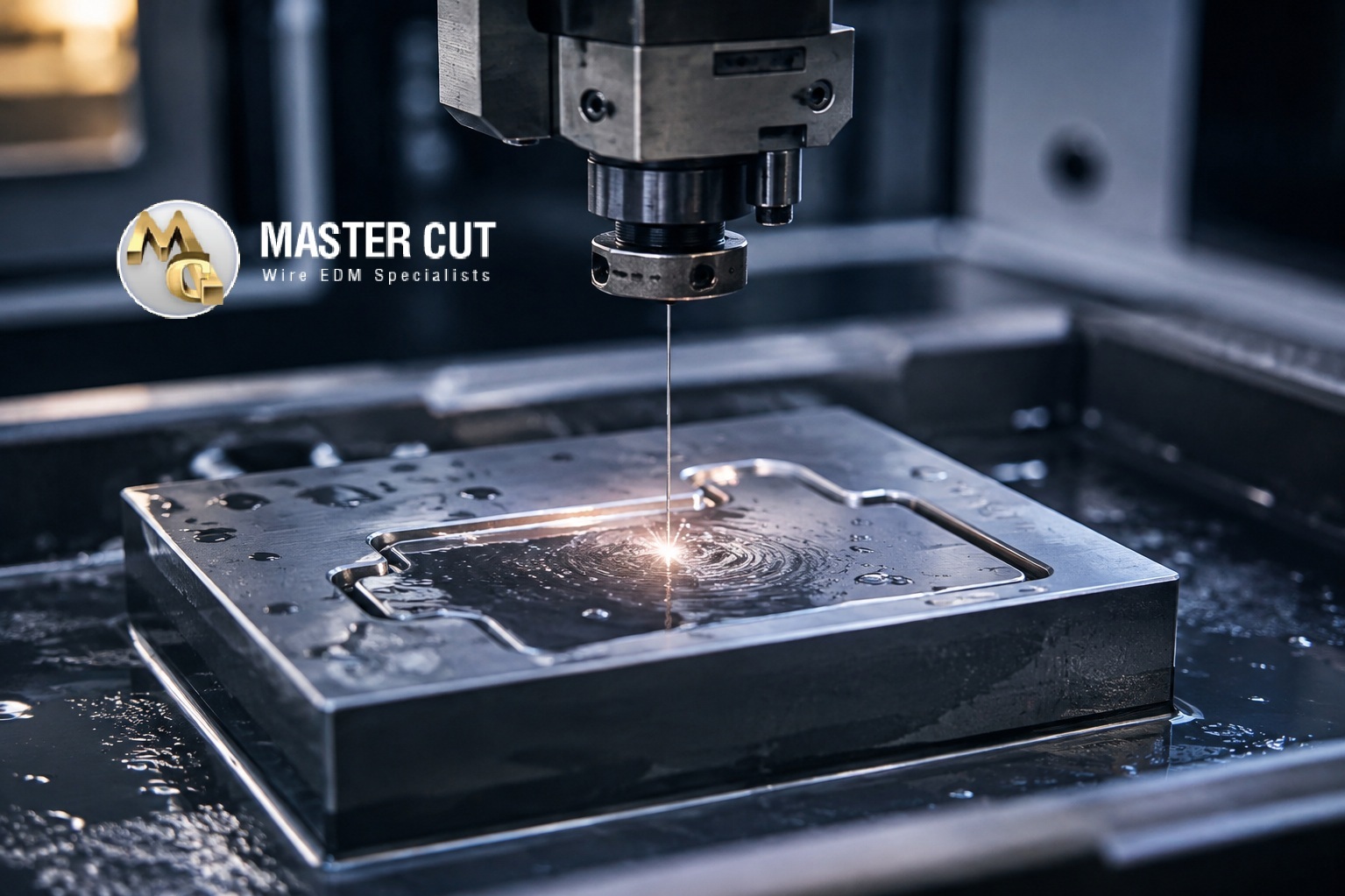
Wire Electrical Discharge Machining (Wire EDM) is one of the most precise manufacturing processes available today. Unlike traditional machining methods that use cutting tools to remove material, Wire EDM relies on a thin, electrically charged wire to cut conductive metals with exceptional accuracy. This process allows manufacturers to produce intricate shapes, sharp internal corners, and extremely tight tolerances that would be difficult or impossible to achieve with conventional machining.
Because of its precision and versatility, Wire EDM is widely used in industries such as aerospace, medical device manufacturing, automotive, defense, electronics, and tool and die production. Let’s take a closer look at wire EDM and how it works.
How Does Wire EDM Work?
Wire EDM uses a continuously fed brass or coated wire as the cutting electrode. The wire never actually touches the workpiece. Instead, electrical sparks jump between the wire and the conductive material while both are submerged in deionized water. Each spark removes a microscopic amount of metal, gradually creating the desired shape.
Since there is no physical contact between the wire and the material, the process produces virtually no cutting forces. This makes Wire EDM an excellent choice for machining delicate parts, thin walls, and intricate geometries without causing distortion.
Computer numerical control (CNC) technology guides the wire along a programmed path, allowing for highly repeatable and accurate results.
What Materials Can Wire EDM Cut?
Wire EDM can machine nearly any electrically conductive material, regardless of hardness. Common materials include:
- Tool steel
- Stainless steel
- Aluminum
- Titanium
- Carbide
- Copper
- Brass
- Inconel and other high-performance alloys
One of the biggest advantages of Wire EDM is that material hardness has little effect on the cutting process. Components can often be machined after they have been heat-treated, eliminating the need for additional finishing operations.
Advantages of Wire EDM
Wire EDM offers numerous benefits over traditional machining methods.
Exceptional Precision
Modern Wire EDM machines can achieve tolerances measured in ten-thousandths of an inch (.0001″), making them ideal for highly detailed and mission-critical components.
Complex Geometries
The process can create intricate contours, fine details, small internal radii, and complex profiles that are difficult to produce using milling or turning.
Excellent Surface Finish
Because material is removed through controlled electrical discharges rather than mechanical cutting, Wire EDM often produces smooth surface finishes that require little or no secondary processing.
Minimal Material Stress
With no direct cutting pressure, Wire EDM minimizes mechanical stress, reducing the risk of warping or damaging delicate components.
Common Applications
Wire EDM is used to manufacture a wide variety of precision components, including:
- Injection mold inserts
- Stamping dies
- Extrusion tooling
- Medical instruments
- Aerospace components
- Precision gears
- Fixtures and gauges
- Prototype parts
Its ability to consistently produce complex, high-accuracy parts makes it a valuable manufacturing solution for both low-volume prototypes and full production runs.
Why Manufacturers Choose Wire EDM
As product designs become increasingly complex and tolerances continue to tighten, manufacturers need machining processes capable of delivering consistent precision. Wire EDM provides an efficient solution for producing intricate parts with outstanding accuracy, excellent repeatability, and superior surface quality.
Whether machining hardened tool steel, exotic alloys, or highly detailed custom components, Wire EDM continues to be one of the most reliable and precise manufacturing technologies available.
Precision Wire EDM & Machining Solutions with Master Cut
When precision matters, choosing the right machining partner can make all the difference. Master Cut EDM specializes in precision wire EDM, small hole EDM, and custom manufacturing solutions for industries that require exceptional accuracy and repeatable results. From prototype development to high-volume production, every project is completed with a focus on quality, efficiency, and meeting demanding engineering specifications.